Bulgaria turns the page, Rumen Radev secures dominant win
Bulgaria has once again gone to the polls in what marks its eighth parliamentary election in just five years, a reflection of the prolonged political instability that has gripped the country. This time, however, the outcome appears far more decisive. Former president Rumen Radev has emerged as the clear winner, with his Progressive Bulgaria party securing a commanding lead that could reshape the country’s political landscape.
According to official results with more than 98 percent of ballots counted, Progressive Bulgaria has won approximately 44.7 percent of the vote. This translates into around 130 seats in the 240-member parliament, giving Radev a strong mandate and raising expectations that Bulgaria may finally achieve a stable government after years of fragile coalitions and repeated elections.
While pre-election polls had predicted a victory for Radev, the scale of his win exceeded expectations. Just days before the vote, projections suggested his party would secure around 34 percent, far below the final result. The significant margin has surprised analysts and strengthened Radev’s political position, potentially allowing him to govern without heavy reliance on coalition partners.
Trailing far behind is the centre-right GERB party, led by former prime minister Boyko Borissov, which received roughly 13.4 percent of the vote. Meanwhile, the reformist PP-DB coalition secured about 12.7 percent, further highlighting the fragmented nature of Bulgaria’s opposition landscape.
Radev, 62, is no stranger to Bulgarian politics. A former air force commander, he served as president for nearly a decade before stepping down earlier this year to pursue the premiership. Throughout his campaign, he positioned himself as an outsider determined to dismantle what he describes as an “oligarchic model” of governance that has long dominated the country.
His message resonated strongly with voters, many of whom have grown increasingly frustrated with corruption scandals, economic challenges, and the constant turnover of governments. Bulgaria, a nation of approximately 6.6 million people, has struggled to maintain political continuity since 2021, with several administrations collapsing due to protests, internal disputes, or no-confidence votes.
Radev played a notable role in shaping the current political climate. In 2025, he publicly supported anti-corruption protests that ultimately led to the of the conservative-backed government of former Prime Minister Rosen Zhelyazkov. During his campaign, he repeatedly called on citizens to participate in large numbers to counter practices such as vote-buying and political manipulation.
At a major rally ahead of the election, Radev pledged to “remove the corrupt, oligarchic model from power,” a promise that became central to his platform. His rhetoric, combined with his image as a strong and independent figure, helped galvanize support across a broad spectrum of voters.
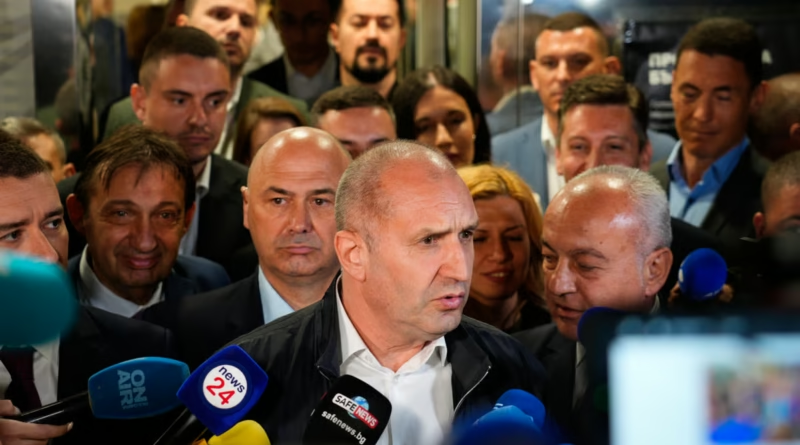
Despite securing a clear majority, Radev has not ruled out the possibility of forming a coalition government. Speaking to reporters after the election, he emphasized the importance of stability and indicated that he is open to cooperation with smaller parties if it serves the national interest.
“We are ready to consider different options so that Bulgaria can have a regular and stable government,” he said, signaling a pragmatic approach to governance despite his strong electoral position.
The election was triggered after Zhelyazkov’s government resigned in December amid a looming no-confidence vote, once again plunging the country into political uncertainty. The campaign that followed was heavily focused on economic issues, particularly the rising cost of living, as well as corruption and governance reforms.
While Radev’s victory offers hope for stability, it also raises important questions about Bulgaria’s future direction, particularly in terms of foreign policy. Observers are closely watching how his leadership will influence the country’s role within the European Union and NATO.
Radev has previously taken positions that suggest a more independent stance in international affairs, which could lead to shifts in Bulgaria’s relationships with its Western allies. However, details of his foreign policy agenda remain unclear, and analysts caution that his next steps will be crucial in determining the country’s trajectory.
For now, the election result represents a turning point for Bulgaria. After years of political deadlock and uncertainty, voters have delivered a strong mandate for change. Whether Radev can translate this support into effective governance and long-term stability remains the key question in the days ahead.