
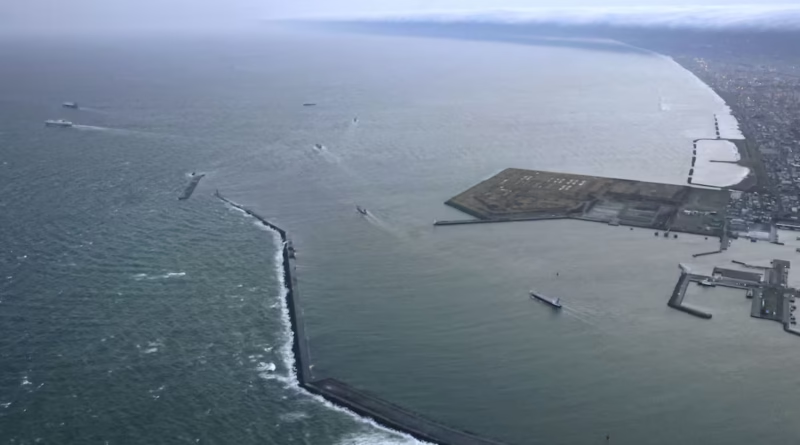
Powerful earthquake rocks Japan, tsunami warning downgraded
A powerful earthquake struck off the northeastern coast of Japan on Monday, triggering widespread concern and a tsunami warning that was later downgraded. According to the Japan Meteorological Agency and the United States Geological Survey, the quake initially measured magnitude 7.4, though Japanese authorities later revised it to 7.7, creating some uncertainty around the exact strength of the event.
The earthquake occurred off the eastern coast of Honshu, Japan’s largest island, prompting authorities to issue an immediate tsunami warning. Initially, waves of up to three meters were forecast for coastal regions including Iwate Prefecture, as well as parts of Hokkaido and Aomori. However, as more data became available, the warning was downgraded to a tsunami advisory, indicating a lower level of threat.

Despite the initial alarm, tsunami waves recorded so far have been significantly smaller than expected. A wave measuring 0.8 meters was observed at Kuji Port in Iwate Prefecture, while another of 0.4 meters struck Miyako Port. Authorities emphasized that even smaller waves can be dangerous due to strong currents, urging residents to remain cautious and avoid coastal areas.
The tsunami advisory, which represents the lowest level of alert, still carries serious implications. The Japan Meteorological Agency warned that waves up to one meter could pose risks to anyone near the shoreline. Residents in affected regions were advised to evacuate immediately to higher ground or designated safe buildings.
In response to the situation, Japan’s disaster management agency issued evacuation orders affecting more than 170,000 people across five prefectures. Emergency services were placed on high alert, and local authorities began assessing potential damage while coordinating evacuation and safety procedures.
Chief Cabinet Secretary Minoru Kihara confirmed that, as of Monday evening local time, no injuries or significant property damage had been reported. However, he stressed that assessments were ongoing and the full extent of the situation was still being determined. He also noted that around 200 power outages had been recorded in affected areas, with crews working to restore electricity as quickly as possible.
Eyewitness accounts from Tokyo highlighted the intensity of the earthquake. A CNN producer reported that the building they were in shook continuously for approximately seven minutes, underscoring the strength and duration of the tremor.
Japanese Prime Minister Sanae Takaichi addressed the nation shortly after the earthquake, urging residents in coastal areas to evacuate without delay. She confirmed that an emergency task force had been established to coordinate response efforts and ensure public safety.
“Residents in areas where tsunami warnings have been issued should immediately evacuate to higher ground or safer locations,” Takaichi stated during a press briefing. She added that authorities were working intensively to assess damage, conduct search and rescue operations, and provide accurate updates to the public.
The prime minister also warned of the possibility of aftershocks, particularly in coastal regions such as Hokkaido and Sanriku. Experts from the Japan Meteorological Agency indicated that earthquakes of similar magnitude could occur within the coming week, increasing the need for continued vigilance.
Transportation services were also affected by the earthquake. The operator of Japan’s high-speed bullet train system reported suspensions on routes between Tokyo and Shin-Aomori due to power outages. Additional disruptions were reported on local and regional train lines, particularly in northern areas such as Akita and Iwate, where services were temporarily halted.
While the situation appears to be stabilizing, authorities continue to monitor developments closely. The combination of aftershock risks, infrastructure disruptions, and ongoing safety assessments means that the coming days will be critical in determining the full impact of the earthquake.